

A busy afternoon, a row of kids asking for something to do, and a tiny window of time before dinner. That is exactly when the Floating Leaves Experiment saves the day. It feels like a small kitchen magic trick: a few spinach disks, a spoon of baking soda, and some light turn into visible bubbles and tiny leaf floaters.
This activity works great when you need a quick, low-prep project that still captures curiosity. It gives a real, hands-on moment without a long setup or a sink full of dishes. If you enjoy quick kitchen science that still teaches something tangible, this is one you can pull together in under 30 minutes, and it pairs nicely with other simple experiments like our balloon baking soda experiment for a whole afternoon of easy discoveries.
Why This Floating Leaves Experiment Works So Well
This project looks small but it fits a busy day.
It uses things you already have: fresh leaves, baking soda, plain water, and a paper towel. That keeps the prep fast and the cost zero for most families.
The steps stay simple. You do a little cutting, a little mixing, and then you watch. Kids see results quickly. That makes it reliable for short attention spans.
You can do it almost anywhere. A kitchen counter, a sunny windowsill, or a patio table all work. The mess stays low, and cleanup usually takes a couple of rinses.
It plays well with routines. Set the leaves while dinner cooks. Let the experiment run while you finish homework help. The waiting time becomes part of the project and gives an easy moment to chat about what’s happening.
Because the results are visual, the experiment feels like a win. Little bubbles appear, disks rise, and children get to tap the cup and examine the fizz. That sense of visible cause and effect makes this activity satisfying and repeatable.
A Quick Look Before You Begin
This activity fits on a short time scale. Active work takes about 10 to 15 minutes. Then you watch for 10 to 30 minutes while the leaves do the rest.
Setup stays minimal. You need a clear cup for watching, a syringe if you have one for drawing disks (it helps but the core recipe works without fancy tools), and a small workspace you can wipe with a paper towel.
Mess stays small. The baking soda water can leave a light residue, and leaf juice can wet surfaces. Keep a damp paper towel handy and a bowl nearby for composting spent leaves.
Adult help matters at the cutting step and when using a syringe. Older kids can do much of the work, but supervise scissors or punches and the handling of glass or sharp tools.
This is a calm project. It gives room for observation and chat. You will likely find everyone standing by the cup, pointing at bubbles, and waiting for that satisfying “pop” when the leaves float.
Materials You’ll Need
Fresh green leaves (such as spinach)
common household item, easy to find at grocery stores or the fridge
Baking soda (sodium bicarbonate)
common household item, inexpensive and shelf-stable
Water
room temperature water works best; tap water is fine
Paper towel
use for cleanup and to pat leaves dry if needed
STEP-BY-STEP DIRECTIONS
- Prepare a baking soda solution by stirring about a teaspoon of baking soda into half a cup of water. Use room temperature water so the baking soda dissolves easily.
Stir until the baking soda looks mostly dissolved and the water looks slightly cloudy.
If a few granules remain, that is okay; the solution will still work. - Use a hole punch or small round cutter to make small leaf disks from fresh leaves.
Press gently and cut disks from the green part of the leaf.
Aim for disks about the size of a dime or nickel so they float evenly. - Put the disks into a clear cup and pour the baking soda solution over them. Gently press them so they sit below the water surface.
Watch that they do not curl up; press with a fingertip or the flat end of a spoon.
You want them sitting flat and just under the surface. - Draw the water and disks into the syringe.
Place the syringe tip under the water and pull back slowly to capture the liquid and disks.
A few disks might cling to the cup sides; guide them gently into the water before drawing. - Release the vacuum and let the disks settle again until they sink evenly.
Push the syringe plunger slowly to release the solution back into the cup.
Give the disks a moment to rest; they should lay flat and sink before you continue. - Pour the disks and solution back into the clear cup and place under a bright light or sun.
Direct light speeds the process because leaves use light to make oxygen bubbles.
A sunny windowsill or a bright lamp works well; avoid full midday heat if outdoors. - Watch the disks over the next 10 to 30 minutes to see how long they take to float, and look for bubbles forming.
Check every few minutes and note where tiny bubbles collect on the surface of the disks.
Timing varies with leaf type, light strength, and how thin the disks are. - Once the disks float, you can gently tap the cup and observe the bubbles.
A light tap sometimes frees bubbles that cling to the top of the disk and helps the disk rise fully.
Kids love this part. It feels like the leaves are “coming alive.” - After the experiment, strain the water and compost the leaf disks. Wash the cup and syringe with soap and water.
Use a paper towel to lift and compost the disks if you do not have a strainer.
Rinse the cup and syringe well and wash with soap to remove any residue.
The Simple Science or Skills at Work
This experiment shows photosynthesis in an easy, visible way.
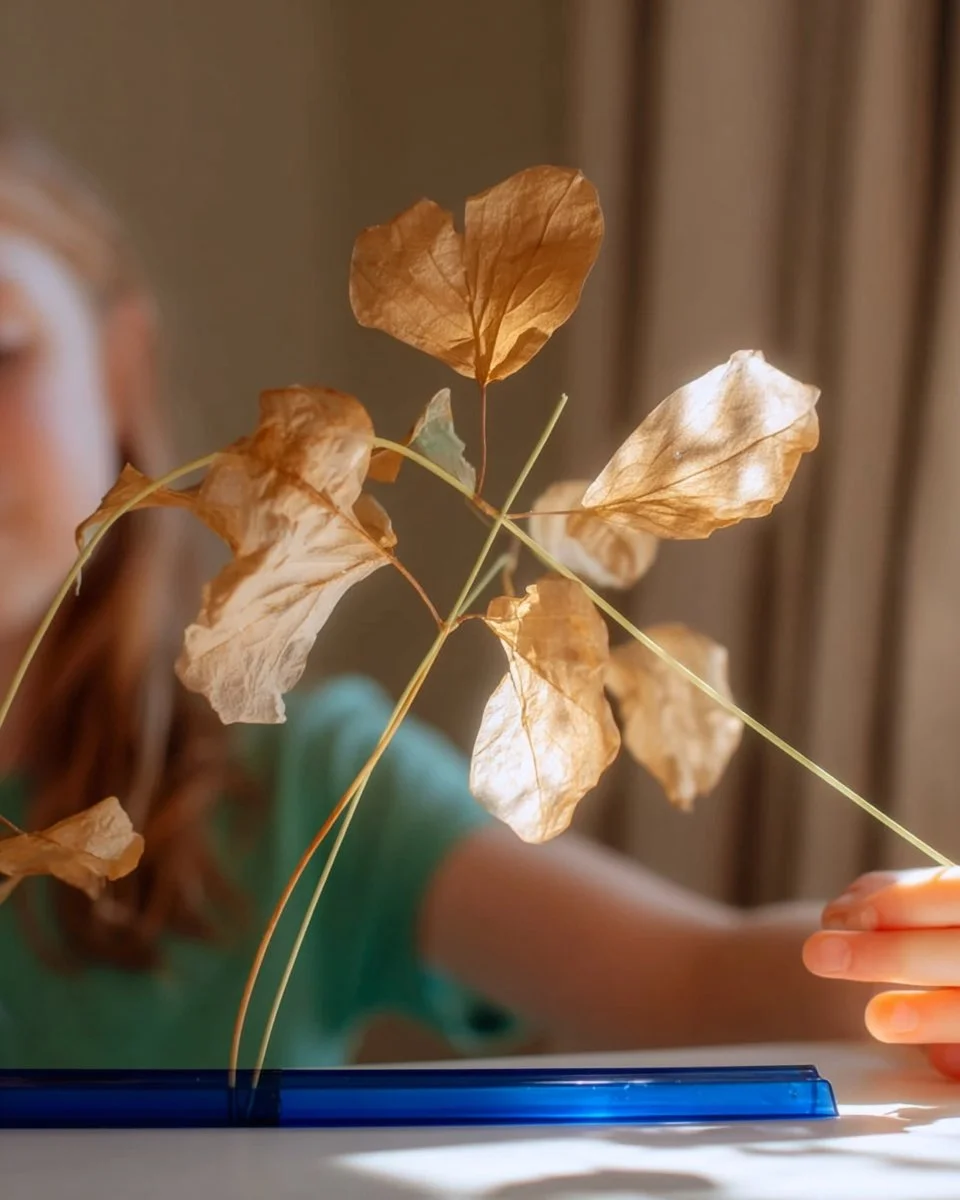
Leaves use light to turn water and carbon dioxide into sugar and oxygen. That oxygen comes off as tiny bubbles. When the bubbles collect under a leaf disk, they push the disk up. Watching disks float makes photosynthesis feel concrete for kids.
You also practice fine motor skills. Punching disks, pressing them into water, and gently tapping the cup all build hand-eye coordination.
Kids learn cause and effect. They see that more light usually means more bubbles and faster floating. When bubbles do not form, that leads to questions and a chance to try again.
The activity builds patience and observation. The timer becomes part of the experiment. Children learn to check changes slowly and note small details like bubble size and where bubbles cling.
Troubleshooting Common Issues
If the disks do not float, they might be too thick or the light might be too weak.
Try thinner disks or move the cup to stronger light.
Also make sure the disks sit flat and fully under the solution at the start.
If you see only large, fast-moving bubbles and not steady small ones, the solution may contain too much baking soda.
Rinse and try again with the suggested teaspoon in half a cup of water. That mix tends to be reliable.
If the disks curl or break, the leaves could be too dry or too old.
Fresh, flexible leaves work best. Pat leaves dry with a paper towel before cutting.
If you get a spill or sticky residue on the table, wipe it with a damp paper towel right away.
Baking soda residues dissolve in water and usually clean off easily.
If kids lose interest during the wait, set short checkpoints.
Say “let’s check in five minutes” and ask them to draw or note the bubbles they see. That keeps them engaged.
If you want help handling fizz from other experiments, our salt volcano science activity has tips that transfer well here, like using a tray for spills and encouraging kids to watch from a small distance.
Easy Variations to Try
Try different leaf types to see which float fastest. Spinach tends to work well because its leaves lie flat, but try basil or lettuce for variety.
Change the light source. Use a bright lamp if it is a cloudy day and compare how quickly disks rise under lamp light versus sunlight.
Make a little timing chart with kids. Record how many minutes each disk took to float and compare results. This turns observation into a simple data game.
Try cutting different disk sizes. Smaller disks may float faster. Let kids experiment and predict which size will win.
Turn it into a guessing game. Ask kids to predict if disks from the outer part of a leaf rise faster than those from the center, then test to see who guessed right.
Storing or Reusing This Project
Compost the leaf disks after the experiment. They break down quickly and leave no lasting waste.
Strain and reuse the baking soda solution one time if it still looks clear. The mixture loses potency after the first experiment but often works for a second quick run.
Rinse and dry your cup and syringe. Soap and water remove baking soda residue and leaf juices. Paper towel drying works fine.
Keep leftover baking soda in a sealed container in the pantry. It stores well and is handy for the next run.
If you want to save notes, tape a small piece of paper to the cup with timing and leaf type. That helps track what worked best for future tries.
FAQs About Floating Leaves Experiment
Can I use store-bought lettuce or herbs instead of spinach?
Yes. Fresh, flexible leaves work best. Some leaves lay flatter and make thicker bubbles more easily. If a leaf curls or is dry, pat it with a paper towel before cutting disks. Don’t expect identical results with every plant.
What if nothing floats after 30 minutes? Did we do something wrong?
Not necessarily. Light strength, leaf age, or disk thickness all change timing. Try thinner disks, brighter light, or fresher leaves next time. It often works on the second try once you tweak one small detail.
Can I save the solution for later?
You can reuse the solution once more if it still looks clear. It loses effectiveness after the first run. If you plan to repeat soon, note the time and leaf type so you can compare the fresh trial with the saved solution.
A Final Helpful Note
This project rewards small changes. If your first run takes a little longer than expected, try one small tweak next time: thinner disks, brighter light, or fresher leaves. That single change often makes the difference.
Keep the mood relaxed. The aim is curiosity and a short burst of discovery, not perfection. Kids remember the bubbles and the moment of floating more than the exact timing.
Encourage questions as you work. Ask what they notice and what they think will happen next. Those small conversations turn a simple activity into a memorable learning moment.
Conclusion
For a classroom-ready explanation and background on why the floating leaf method shows photosynthesis in action, check the clear instructions at Measure Photosynthesis with Floating Leaves | STEM Activity to deepen your understanding and find reproducible student materials.
If you want another hands-on take on how plants produce gas and buoyancy, the Exploratorium offers a practical guide with useful visuals at Photosynthetic Floatation: : Biology & Physics Science Activity to inspire further experiments and classroom play.
PrintFloating Leaves Experiment
A simple and captivating kitchen science experiment demonstrating photosynthesis using fresh leaves and baking soda.
- Prep Time: 15 minutes
- Cook Time: 30 minutes
- Total Time: 45 minutes
- Yield: 4 servings
- Category: Activity
- Method: Experiment
- Cuisine: Not Applicable
- Diet: Vegetarian
Ingredients
- Fresh green leaves (such as spinach)
- Baking soda (sodium bicarbonate)
- Water (room temperature)
- Paper towel
Instructions
- Prepare a baking soda solution by stirring about a teaspoon of baking soda into half a cup of water.
- Stir until the baking soda looks mostly dissolved and the water appears slightly cloudy.
- Use a hole punch or small cutter to make small disks from fresh leaves.
- Put the disks into a clear cup and pour the baking soda solution over them.
- Draw the water and disks into a syringe, ensuring the disks are submerged.
- Release the vacuum and let the disks settle before gently pouring back into the cup.
- Place the cup under a bright light to speed up the photosynthesis process.
- Observe the disks over 10 to 30 minutes as they begin to float and see bubbles forming.
- Once the disks float, gently tap the cup to observe the bubbles.
- Compost the leaf disks and clean the cup and syringe after the experiment.
Notes
Supervise children during cutting steps and when using glass or sharp tools. Expect a light mess and keep a damp paper towel handy for quick cleanups.
Nutrition
- Serving Size: 1 experiment
- Calories: 50
- Sugar: 0g
- Sodium: 1mg
- Fat: 0g
- Saturated Fat: 0g
- Unsaturated Fat: 0g
- Trans Fat: 0g
- Carbohydrates: 13g
- Fiber: 1g
- Protein: 1g
- Cholesterol: 0mg